For many years, businesses became used to a financial environment where debt was relatively cheap. Borrowing to fund expansion, purchase equipment, acquire property, support working capital, or invest in growth often felt manageable because interest costs were low. In that environment, many companies focused mainly on whether they could obtain finance, rather than whether the business could comfortably sustain that finance under different conditions.
That mindset has changed.
Although interest rates have started to stabilise in some markets, borrowing remains a much more important strategic decision than it was during the low-rate years. In the euro area, the European Central Bank decided in April 2026 to keep its key interest rates unchanged, with the deposit facility at 2.00%, main refinancing operations at 2.15%, and the marginal lending facility at 2.40%. The ECB also noted that uncertainty remains significant, particularly due to inflation risks and weaker growth concerns.
For businesses, the practical lesson is simple. Debt can still be useful, but it needs to be managed with more discipline.
When interest rates rise, the impact is not limited to new loans. Existing facilities may also become more expensive if they are linked to variable rates or need to be refinanced. A loan that looked affordable two or three years ago may place more pressure on cash flow today if repayment costs increase or if the company's revenue does not grow as expected.

This is especially relevant for businesses with thin margins, seasonal income, slow-paying customers, or heavy working capital needs. In these cases, higher finance costs can reduce flexibility quickly. The business may still be profitable on paper, but if too much cash is being used to service debt, management may struggle to pay suppliers, invest in operations, or respond to unexpected costs. Building stronger habits around financial planning and cost visibility is often what reveals this pressure before it becomes a problem.
This is why cash flow forecasting has become more important. A business should not only ask, "Can we afford this loan today?" It should also ask, "Can we afford it if revenue drops, if clients pay late, if costs increase, or if refinancing becomes more expensive?"
The International Monetary Fund has warned that spikes in bond yields can be amplified by rollover risks and funding market stress, with possible spillovers into credit markets. While that analysis focuses on broader financial stability, the same concept applies at company level. Refinancing risk matters. If a business depends on renewing or replacing debt at a future date, it should consider whether that future debt will be available on acceptable terms.
The change in interest rates also affects how banks assess businesses. Lenders are likely to pay close attention to repayment capacity, cash flow quality, financial statements, debtor balances, tax compliance, and the strength of management accounts. A business seeking finance today needs to be ready to show more than ambition. It needs to show numbers that support the story.
This is where many SMEs face difficulties. They may have a good business, strong relationships, and healthy sales, but weak financial reporting can make funding harder. If management accounts are outdated, debtor balances are unclear, margins are not properly analysed, or cash flow forecasts are missing, banks may see more risk than the business owner expects. This is precisely the kind of gap that the right accounting, tax and advisory support is designed to close.
The table below contrasts the questions that defined borrowing in the low-rate years with the questions businesses should be asking now.
| Borrowing in the low-rate era | Borrowing in a higher-rate environment |
|---|---|
| Can we obtain finance? | Can we sustain this finance if conditions change? |
| Focus mainly on the loan amount and approval | Focus on repayment source, rate sensitivity, and cash flow impact |
| Debt assessed when applying for a new loan | Debt reviewed regularly via a live debt schedule |
| Affordability judged on today's revenue | Affordability stress-tested against lower sales and late payments |
| Debt seen largely as a funding question | Debt seen as part of wider financial management |
Debt also needs to be matched with purpose. Borrowing to fund productive investment is different from borrowing to cover recurring losses or poor cash management. A loan used to purchase equipment that increases capacity, improves efficiency, or supports contracted revenue may be commercially sensible. A loan used repeatedly to cover unpaid debtors, unmanaged costs, or weak pricing may only delay a deeper issue.
This distinction matters because debt does not fix the business model. It gives the business time, liquidity, or investment capacity. If the underlying issue is low margins, slow collections, weak controls, or poor planning, debt can make the problem bigger.
Another important point is that interest costs directly affect profitability. Businesses often focus on revenue growth, but higher finance costs can reduce net profit even when sales are increasing. A company may grow turnover and still see weaker results if debt servicing, wages, rent, materials, and other costs rise faster than income.
This is why business owners should review debt alongside pricing and margins. If borrowing costs increase and the company does not adjust pricing, improve efficiency, or manage costs, profitability may gradually weaken. In some industries, this pressure is already visible as businesses face higher input costs, wage expectations, and more selective consumer spending.
Globally, economic growth also remains uneven. The World Bank has highlighted that the world economy has shown resilience, but longer-term growth remains weaker than in previous periods. A slower growth environment can affect demand, investment appetite, and business confidence, which makes careful debt planning even more important.
For directors, the key is not to avoid debt entirely. Debt can still be an important tool for growth. Many businesses need financing to invest, expand, modernise, or manage working capital. The issue is whether debt is being used with a clear financial plan.
A good debt decision should consider the reason for borrowing, repayment source, interest rate sensitivity, security required, impact on cash flow, tax implications, and alternative funding options. It should also include scenario planning. What happens if sales are 10% lower than expected? What happens if customers pay 30 days later? What happens if costs increase? What happens if refinancing is not available on the same terms?
Businesses should also review existing debt regularly. Many companies only think about financing when applying for a new loan. A better approach is to maintain a debt schedule showing loan balances, repayment dates, interest rates, security, covenants, and renewal dates. This gives management a clearer view of future obligations and helps avoid surprises.
In the current environment, the strongest businesses are likely to be those that understand debt as part of wider financial management. They track cash flow, prepare reliable accounts, monitor margins, manage debtors, and make borrowing decisions based on evidence rather than optimism.
Higher interest rates have not made debt irrelevant. They have made discipline more important.
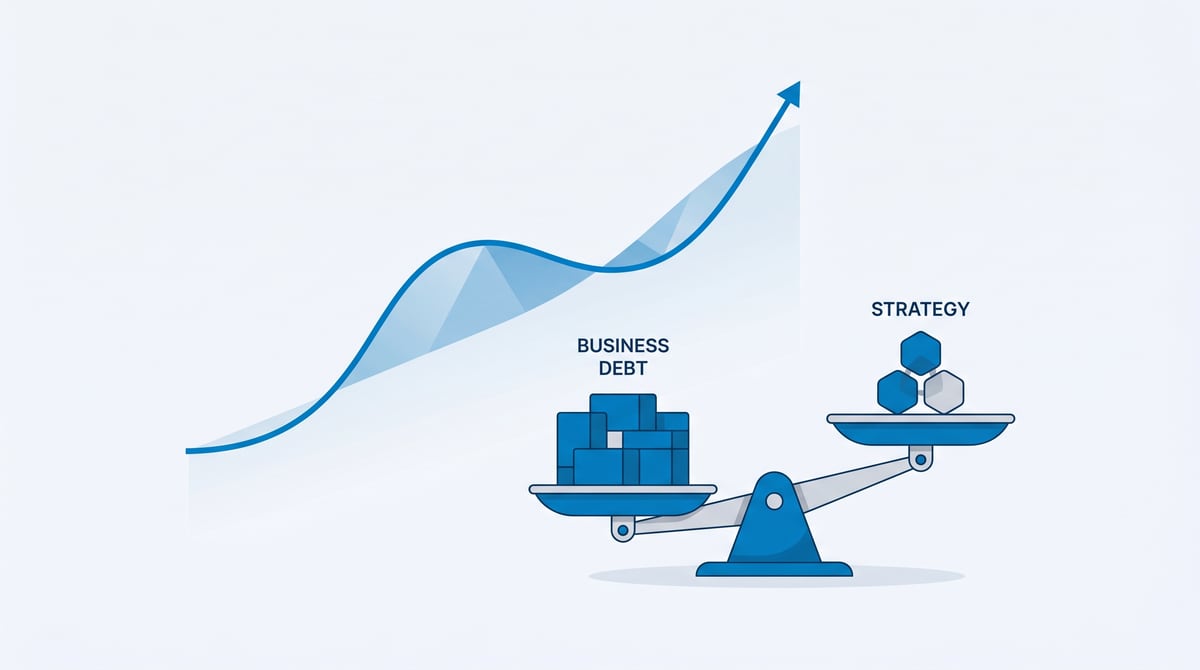
For businesses, the lesson is clear. Borrowing should support strategy, not cover avoidable financial weakness. Companies that understand their numbers, plan ahead, and communicate clearly with lenders will be better positioned to use debt responsibly and sustainably. If you would like a clearer view of your debt position before your next financing decision, it is worth speaking to an advisor.
Sources & References
- European Central Bank. "Monetary policy decisions, 30 April 2026." Available at: https://www.ecb.europa.eu/
- International Monetary Fund. "Global Financial Stability Report, April 2026." Available at: https://www.imf.org/
- World Bank. "Global Economic Prospects." Available at: https://www.worldbank.org/
- OECD. "Global Debt Report 2026." Available at: https://www.oecd.org/