
Why Email Is Failing Professional Services
Category: Professional Services & Technology
Tags: client communication, professional services, email management, client records, accounting firms, document management, business efficiency, compliance workflows
Email is one of the most used tools in professional services.
It is also one of the biggest sources of confusion.
For many firms, email is used for almost everything. Client communication, document requests, approvals, reminders, deadline discussions, file sharing, internal comments, and follow-ups all happen inside the inbox.
At a small scale, this can work.
But as a firm grows, email starts to show its limits.
Email Was Built for Communication, Not Workflow
Email is useful for sending messages.
It was not designed to manage complex professional service workflows.
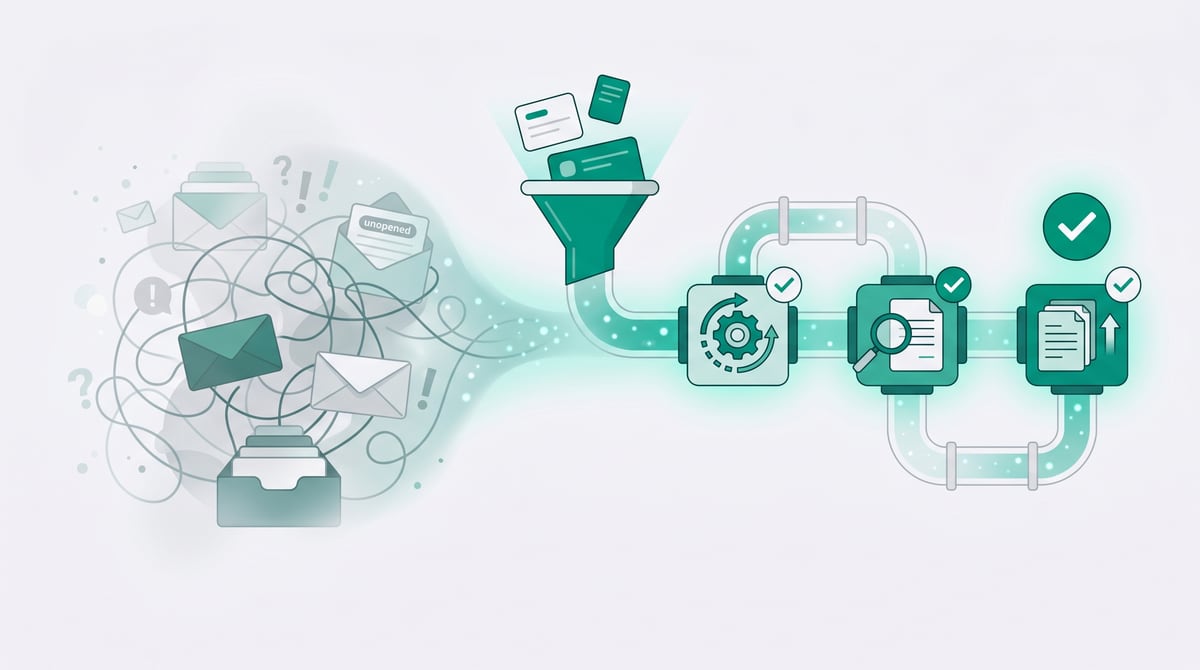
Accounting firms, audit firms, legal firms, compliance providers, and consultants all need more than communication. They need to track tasks, collect documents, review information, manage deadlines, assign responsibility, and maintain clear records.
Email does not do this properly by itself.
It can tell you that a message was sent. But it does not clearly show whether a task is complete, whether a document was reviewed, whether the latest version is being used, or whether a deadline is at risk.
That creates problems.
Important Information Gets Buried
One of the biggest issues with email is that important information gets buried quickly.
A client may send an invoice, then reply again with a correction, then send another document in a separate thread, while an internal team member discusses the same matter elsewhere.
Soon, the full picture is spread across different messages.
Finding the right information becomes difficult.
This is especially problematic when a firm needs to prepare VAT returns, complete audit work, update KYC files, or respond to a client quickly.
Time is wasted searching instead of reviewing.
Email Creates Version Confusion
Professional service work often involves documents.
Engagement letters, financial statements, payroll files, tax computations, KYC forms, management accounts, contracts, invoices, and reports may all go through different versions.
When these documents are exchanged by email, version control becomes difficult.
A team may not know which file is final. A client may reply to an old version. An attachment may be saved in the wrong folder. A corrected document may be missed.
These issues are not always obvious immediately.
But they can create serious problems later.
Email Makes Accountability Harder
In a busy firm, it is important to know who is responsible for each task.
Email does not always make this clear.
A client request may be copied to several people. Everyone assumes someone else will respond. A document request is sent, but no one tracks whether the client replied. A deadline is mentioned in an email, but not assigned properly.
This creates gaps in accountability.
The issue is not that people are careless. The issue is that the tool does not provide enough structure.
Client Experience Suffers
Clients also feel the effect.
When communication depends too heavily on email, clients may receive repeated requests for the same documents, unclear instructions, long email threads, and delayed responses.
They may not know what is still pending.
They may not know whether the firm received their documents.
They may not know what stage the work is at.
This can make the service feel less organized, even when the firm is working hard in the background.
A good client experience requires visibility, not only communication.
Compliance Work Needs Better Records
Professional service firms often deal with sensitive and regulated information.
KYC files, audit evidence, tax records, payroll data, financial documents, and client approvals all need to be handled carefully.
When too much of this is stored in email, record management becomes weaker.
Documents may be difficult to locate, approvals may be unclear, and the firm may struggle to evidence when information was requested, received, reviewed, or updated.
For compliance-related work, this matters.
A firm should not have to rely on inbox searches to prove that important steps were completed.
Email Increases Internal Pressure
Email also creates pressure for teams.
Inboxes become crowded. Messages arrive constantly. Important items compete with low-priority updates. Staff spend large parts of the day checking, forwarding, searching, and replying.
This can make teams feel busy without necessarily being productive.
The firm may be doing a lot of communication, but still lack a clear operational view of what is happening.
That is a problem.
What Firms Should Use Instead
Email does not need to disappear completely.
It will still have a role in professional communication.
But firms should avoid using email as the main system for managing work.
Better alternatives include:
- client portals,
- document management systems,
- workflow tools,
- task tracking systems,
- secure upload links,
- automated reminders,
- and structured internal review processes.
The goal is not to make communication complicated.
The goal is to make work visible.
A firm should be able to see what has been requested, what has been received, what is pending, who is responsible, and what needs review.
The table below summarises where email falls short and what a structured approach offers instead.
| What firms need | Relying on email | A structured approach |
|---|---|---|
| Document collection | Files scattered across threads and attachments | One place to upload, with received and outstanding items visible |
| Version control | Unclear which file is final | A single current version everyone works from |
| Accountability | Requests copied to many, owned by no one | Tasks assigned with clear responsibility |
| Compliance records | Reliance on inbox searches to prove steps | An auditable record of requests, receipts, and reviews |
| Client visibility | Clients unsure what is pending | Clear status of what has been done and what remains |
Many of these structured workflows are exactly what a modern client portal and document workflow is designed to provide, and they often start with bringing order to the underlying numbers and processes through an accounting health check.
Conclusion
Email is not failing because it is useless.
It is failing because firms are asking it to do too much.
Professional service work has become more document-heavy, deadline-driven, and compliance-sensitive. Relying only on email creates confusion, delays, version issues, and weak visibility.
Firms that want to improve service quality should not only think about how they communicate.
They should think about how they manage the work behind the communication. If you would like to discuss moving your firm beyond the inbox, speak to our team.