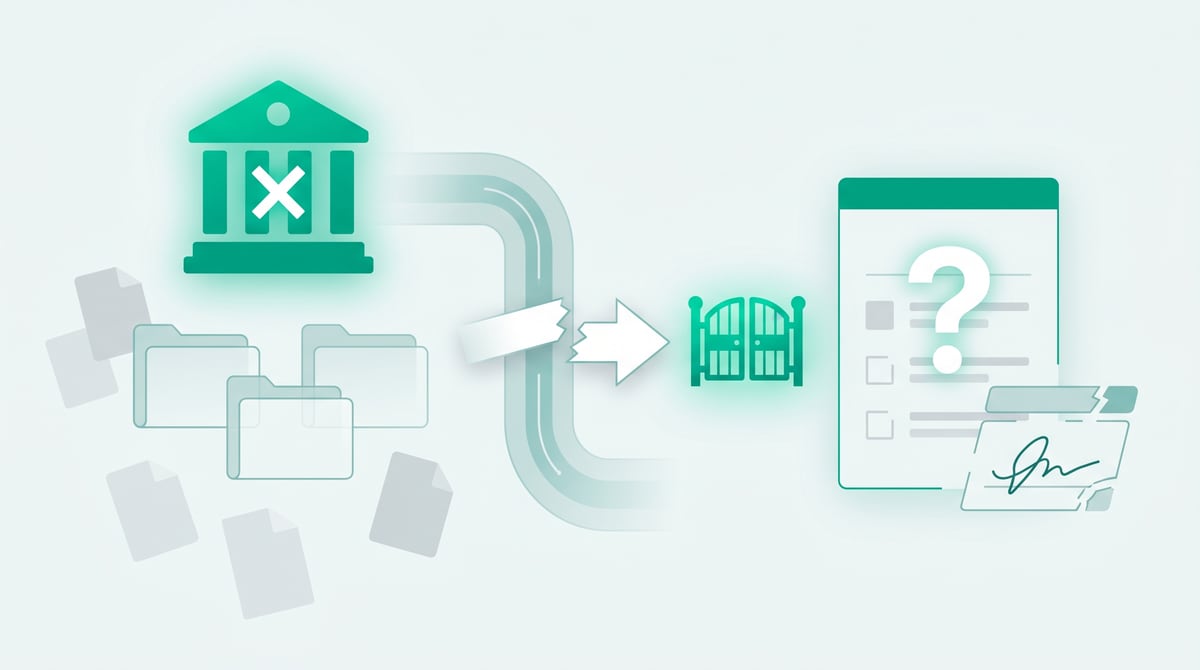
Why Banks Reject Companies and How to Prepare for Bank Onboarding
Opening a corporate bank account is no longer a routine step. In the EU, banks must assess risk before onboarding a new customer, and they must be able to show that their checks were reasonable and documented.
When a company is rejected, it is often because the bank cannot complete its required due diligence with confidence, not because the business is “bad”.
Due diligence is a legal requirement
EU anti-money laundering rules require banks to identify the customer, verify beneficial ownership, and understand the purpose and intended nature of the business relationship before onboarding (European Union, 2015, Art. 13). These obligations were reinforced by later amendments (European Union, 2018).
In practice, this means the bank needs a clear picture of who owns the company, who controls it, what it does, and what activity to expect through the account. Getting your accounting and corporate records in order before you apply often makes this picture far easier for a bank to verify.
Beneficial ownership and source of funds are central
International standards also emphasise transparency of beneficial ownership and risk-based customer due diligence. FATF Recommendations set out expectations around identifying beneficial owners and applying appropriate checks, including enhanced measures where risk is higher (FATF, 2025, Rec. 10 and 24).
If ownership is layered across jurisdictions, or if source-of-funds documentation is missing or inconsistent, the bank may decide it cannot meet its obligations and will decline the relationship (FATF, 2025, Rec. 10).
“Substance” matters because banks look for credibility
Even when substance rules are tax-driven, they reflect a broader principle: structures should align with real economic activity. The OECD’s BEPS Action 5 Final Report links preferential outcomes to expectations of real activity and substance rather than purely formal arrangements (OECD, 2015).
From a bank’s perspective, a company that has no clear operational footprint, unclear decision-making location, or a weak commercial rationale can appear higher risk because the story does not match the structure (OECD, 2015).
Common reasons banks decline companies
Most rejections come back to the same themes:
- ownership is unclear or overly complex (European Union, 2015, Art. 13; FATF, 2025, Rec. 24)
- the business activity is not explained clearly enough to predict account behaviour (European Union, 2015, Art. 13)
- source of funds is not properly evidenced (FATF, 2025, Rec. 10)
- the structure and operations do not align (OECD, 2015)

The table below maps each common reason for rejection to what a bank is actually trying to confirm, and the kind of evidence that addresses it.
| Common reason for rejection | What the bank needs to confirm | How to address it |
|---|---|---|
| Ownership is unclear or overly complex | Who ultimately owns and controls the company | A clear ownership chart up to the ultimate beneficial owner, supported by documents |
| Business activity not explained clearly | What the company does and how the account will behave | A plain explanation of the business model, customers, and why the structure is needed |
| Source of funds not properly evidenced | Where the money comes from | A clean source-of-funds narrative with documentary evidence |
| Structure and operations do not align | That the structure reflects real economic activity | Proof that operations are real: contracts, invoices, premises/people, decision-making |
How to prepare
A strong onboarding file is usually simple, consistent, and verifiable. Before approaching a bank, prepare:
- A clear ownership chart up to the ultimate beneficial owner, supported by documents.
- A plain explanation of the business model, customers, and why this structure is needed.
- A realistic description of expected activity (currencies, countries, monthly volumes, counterparties).
- A clean source-of-funds narrative with documentary evidence.
- Proof that operations are real (contracts, invoices, premises/people, decision-making), where relevant.
Banks approve relationships they can understand and justify. The goal is not to “look good”. It is to provide enough clarity for the bank to complete its legal and risk requirements. If you are unsure whether your file is ready, it is worth speaking to an advisor before you submit your application.
References
European Union. Directive (EU) 2015/849 (Fourth Anti-Money Laundering Directive).
https://eur-lex.europa.eu/legal-content/EN/ALL/?uri=celex%3A32015L0849
European Union. Directive (EU) 2018/843 (Fifth Anti-Money Laundering Directive), amending Directive (EU) 2015/849.
https://eur-lex.europa.eu/legal-content/EN/TXT/?uri=celex%3A32018L0843
Financial Action Task Force (FATF). The FATF Recommendations (updated October 2025).
https://www.fatf-gafi.org/en/publications/Fatfrecommendations/Fatf-recommendations.html
OECD. Countering Harmful Tax Practices More Effectively, Taking into Account Transparency and Substance: Action 5 – 2015 Final Report.