
The End of Spreadsheet Accounting: How Automation Is Reshaping Financial Operations
For many years, spreadsheets have been the default tool for managing financial information. Bookkeeping records, reconciliations, forecasts, and reporting models have often lived inside complex Excel files shared across teams.
Spreadsheets became popular because they were flexible and accessible. With formulas and manual adjustments, almost any financial process could be recreated inside them.
However, as businesses grow and financial operations become more complex, the limitations of spreadsheet-based workflows become increasingly visible. Modern financial systems require structured data, traceability, integration with other platforms, and continuous oversight.
What once worked as a practical solution for small operations often becomes fragile when organisations scale.
Accounting is gradually shifting away from spreadsheets as a core system and toward automated financial infrastructure.
The Structural Limitations of Spreadsheet-Based Accounting
Spreadsheets were never designed to operate as financial systems.
They are powerful tools for calculations and modelling, but they lack several features that modern financial operations require. These include structured audit trails, access control, automated validation of data, and integration with other operational systems.
Research into spreadsheet risk has shown that errors are common even in carefully designed spreadsheets. Studies reviewed by the European Spreadsheet Risk Interest Group highlight how complex spreadsheets frequently contain hidden formula errors, inconsistent logic, or undocumented adjustments (EuSpRIG, 2023).
The issue is not limited to errors. Spreadsheet workflows often rely on multiple files exchanged between teams through email or shared drives. Different versions of the same document can circulate simultaneously, making it difficult to determine which dataset represents the authoritative financial record.
As financial data grows in volume and importance, these structural weaknesses become increasingly difficult to manage.
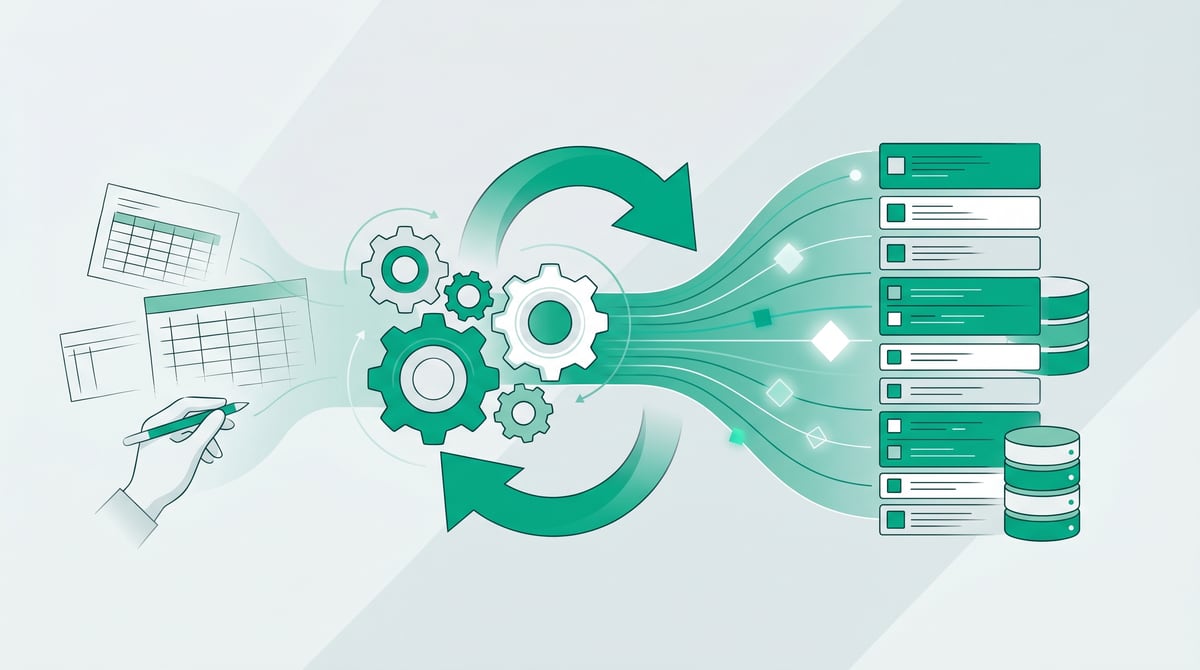
The table below contrasts the structural characteristics of spreadsheet-based workflows with those of automated financial systems.
| Capability | Spreadsheet-based workflows | Automated financial systems |
|---|---|---|
| Audit trail | Limited or undocumented | Structured and traceable |
| Data validation | Manual checks | Automated validation |
| Version control | Multiple circulating files | Single authoritative record |
| Integration | Manual export and import | Direct integrations and APIs |
| Reconciliation | Periodic manual checks | Continuous and near real time |
This shift toward structured systems is central to modern automated bookkeeping.
The Rise of Automated Financial Systems
In response to these limitations, accounting infrastructure has evolved toward automated financial systems.
Modern accounting platforms bring together several processes that were historically handled separately. Transaction capture, document management, reconciliation, and reporting can now operate within a single environment.
Automation reduces the need for repetitive manual work. Bank transactions can be imported automatically, invoices can be digitised through document recognition tools, and reconciliation can occur continuously rather than through periodic manual checks.
Artificial intelligence is also beginning to support financial processes by identifying anomalies in transactions, assisting with categorisation, and improving audit analysis.
The role of accounting shifts as a result. Instead of assembling financial information after the fact, systems can maintain an accurate and up to date financial record in real time.
Digitalisation as a Regulatory Direction
The movement toward automated financial systems is not driven only by operational efficiency. Regulatory frameworks increasingly encourage digital financial infrastructure.
Across Europe, public authorities have introduced initiatives designed to support the digital transformation of businesses. The European Commission has highlighted the importance of digital tools and data-driven systems for improving transparency, productivity, and compliance across the economy (European Commission, 2023).
Tax administrations are also evolving toward more digital environments. The OECD has described the concept of Tax Administration 3.0, which envisions tax reporting becoming increasingly integrated with digital business systems and automated financial data flows (OECD, 2020).
These developments mean that financial data must be stored and processed within structured systems capable of supporting digital reporting requirements. Spreadsheet workflows often struggle to meet these expectations.
As digital reporting becomes more common, businesses are encouraged to adopt financial systems that can interact directly with regulatory infrastructure.
Integration and the Financial Operations Stack
Another challenge with spreadsheet accounting is its limited ability to integrate with other operational systems.
Modern businesses operate across many platforms including banking systems, payment processors, payroll tools, and enterprise resource planning systems. Financial data flows continuously between these systems.
When spreadsheets sit at the centre of accounting processes, this flow of information often becomes manual. Data must be exported from one platform and imported into another. Each transfer introduces the possibility of delays, duplication, or errors.
Automated accounting systems solve this problem through direct integrations and application programming interfaces. Transactions can be recorded automatically from payment providers, reconciliations can occur as data flows through the system, and reporting can be generated from live financial information.
Accounting therefore becomes part of a connected operational infrastructure rather than a separate administrative function.
From Manual Accounting to Financial Infrastructure
The shift away from spreadsheet accounting reflects a broader transformation in how organisations view financial operations.
Accounting is no longer simply a record of past activity. It has become a system that supports governance, compliance, and decision-making.
Structured financial systems allow businesses to maintain visibility over their operations and respond quickly to regulatory obligations. They also provide stakeholders such as auditors, investors, and financial institutions with clearer access to reliable financial information.
This transformation reflects a wider digital shift across professional services and corporate management, and increasingly shapes how integrated accounting and advisory services are delivered.
Conclusion
Spreadsheets have played a significant role in the development of modern accounting. Their flexibility allowed businesses to manage financial information long before sophisticated accounting systems became widely available.
However, the demands placed on financial operations have changed. Businesses now operate in environments where data volumes are larger, regulatory oversight is stronger, and financial reporting must often occur in near real time.
Automation and integrated financial systems are gradually replacing spreadsheet-based workflows. Spreadsheets are unlikely to disappear entirely, but their role is changing. They are increasingly used as analytical tools rather than as the foundation of financial systems.
For organisations operating in a digital and regulated environment, structured financial infrastructure is becoming essential. An accounting health check is a practical way to see how far your current processes still depend on fragile spreadsheets.
References (Official Sources)
European Commission. Digital Transformation of SMEs.
https://commission.europa.eu/projects/digital-transformation-smes_en
European Spreadsheet Risk Interest Group (EuSpRIG). Research and Best Practice.
https://eusprig.org/research-info/research-and-best-practice/
Organisation for Economic Co-operation and Development. Tax Administration 3.0: The Digital Transformation of Tax Administration.