
Artificial intelligence is no longer something that accounting firms can treat as a future topic.
It is already changing how information is processed, how records are reviewed, how clients communicate, and how firms deliver value.
For many years, accounting work has depended heavily on manual checks, document collection, reconciliations, spreadsheets, emails, and repeated administrative tasks. These tasks are important, but they also take time. They create pressure during deadlines. They increase the risk of human error. And they often leave less time for proper review, advice, and planning.
AI is beginning to shift that balance.
It does not mean that accountants, auditors, or bookkeepers will become unnecessary. In fact, the opposite is more realistic. The firms that use technology properly may be able to deliver better work, faster responses, clearer reporting, and stronger support to their clients.
The role of the accounting firm is changing from simply processing information to helping businesses understand it.
Why Accounting Firms Are Ready for Change
Accounting firms deal with large amounts of repetitive information every day.
This includes:
- supplier invoices,
- sales invoices,
- bank statements,
- payroll records,
- VAT documentation,
- management accounts,
- client correspondence,
- audit files,
- KYC documents,
- and compliance records.
Much of this information follows patterns.
Invoices have dates, supplier names, VAT numbers, totals, and descriptions. Bank statements have transaction dates, descriptions, and balances. Financial statements follow structured reporting formats. Audit files contain recurring documents and checklists.
This is exactly where AI can be useful.
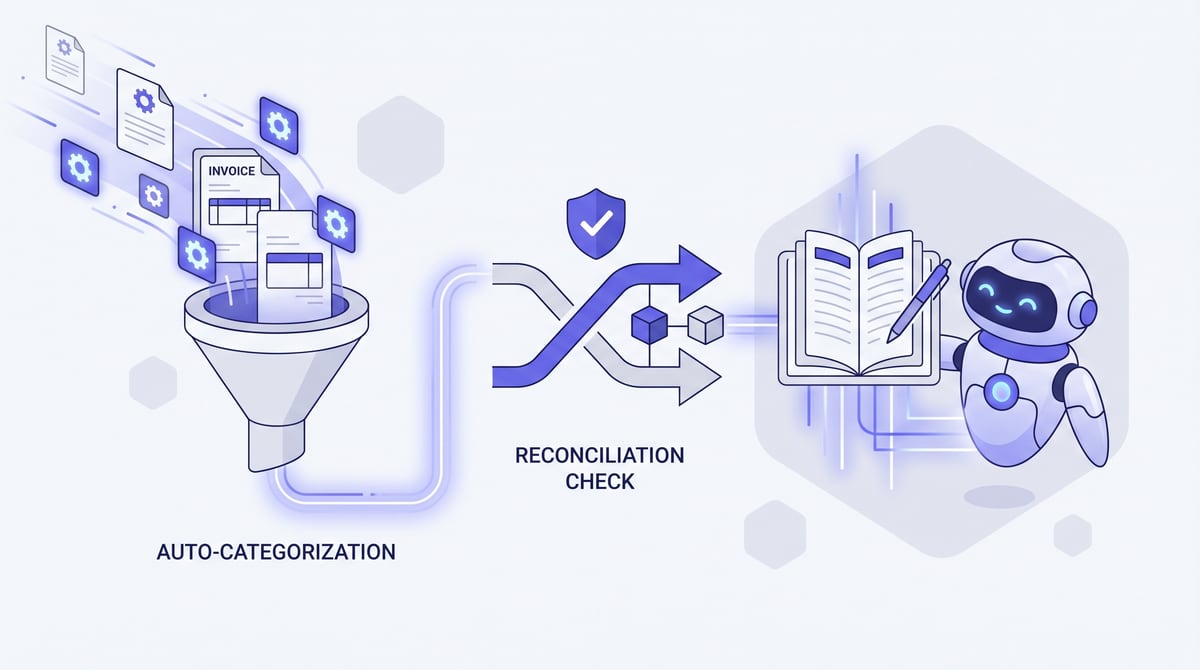
AI can help extract information, identify inconsistencies, compare documents, summarize records, and highlight areas that may need review. It can reduce the amount of time spent searching, copying, checking, and organizing data.
That does not remove the need for professional judgement. It simply allows professionals to spend less time on mechanical work and more time on the parts that require experience.
The table below summarises where AI tends to add value across firm functions compared with what still depends on professional oversight.
| Firm function | Where AI adds value | What still needs human oversight |
|---|---|---|
| Bookkeeping | Reading invoices, extracting details, matching entries | Reconciliations, review, and final sign-off |
| VAT and compliance | Flagging missing invoices and unusual VAT rates | Compliance decisions and regulatory judgement |
| Audit | Summarising documents and identifying unusual transactions | Risk assessment and quality of evidence |
| Client service | Faster status updates and document handling | Commercial context and trusted advice |
These efficiencies sit alongside the firm's professional accounting, tax and advisory services, not in place of them.
AI Can Improve Bookkeeping Processes
Bookkeeping is one of the areas where AI can make an immediate difference.
Many businesses still send documents through email, WhatsApp, shared folders, or even paper files. This creates delays and makes it harder to keep records complete.
AI-powered systems can help by reading invoices, extracting key information, classifying transactions, and matching documents to accounting entries.
For example, instead of manually entering invoice details one by one, a system may be able to identify:
- the supplier,
- invoice date,
- invoice number,
- VAT amount,
- total amount,
- category of expense,
- and whether the invoice matches a bank payment or accounting entry.
This can reduce manual entry and improve the quality of records.
However, AI should not be treated as a replacement for review. A good bookkeeping process still needs checks, reconciliations, and proper oversight. The real benefit is that the first layer of work can become faster and more organized, which is the principle behind structured, technology-supported automated bookkeeping.
AI Can Support VAT and Compliance Work
VAT compliance depends heavily on accurate records.
If invoices are missing, VAT numbers are incorrect, transactions are posted to the wrong period, or supporting documentation is not available, problems can appear later during VAT reviews or audits.
AI can help firms detect some of these issues earlier.
For example, technology can assist with:
- identifying missing invoices,
- checking VAT amounts against invoice totals,
- flagging unusual VAT rates,
- comparing accounting records with supporting documents,
- organizing documentation by reporting period,
- and highlighting transactions that may require further review.
This is important because compliance issues are often not caused by one large mistake. They usually develop from small operational gaps that repeat over time.
AI can help make those gaps more visible.
AI Will Change the Audit Process
Audit work is also likely to be affected significantly.
Audits involve reviewing documents, testing balances, comparing figures, understanding risks, checking consistency, and preparing working papers. Many of these tasks require professional judgement, but they also involve a lot of document handling and data review.
AI can help auditors by:
- summarizing large documents,
- extracting information from contracts and invoices,
- comparing figures across records,
- identifying unusual transactions,
- assisting with audit planning,
- and helping organize audit evidence.
This can make audit files more efficient and easier to review.
It may also allow auditors to focus more on risk, business understanding, and the quality of evidence rather than spending excessive time searching through documents.
The future audit process will likely be more data-driven, more continuous, and more focused on exceptions rather than manual sampling alone, reshaping how audit services are planned and delivered.
Clients Will Expect Faster and Clearer Service
AI will not only change internal firm operations. It will also change what clients expect.
Clients are becoming used to faster digital services in banking, travel, shopping, and communication. Over time, they will expect the same from professional service providers.
They may expect:
- faster replies,
- clearer dashboards,
- real-time document status,
- easier uploads,
- better visibility over deadlines,
- and more proactive advice.
An accounting firm that relies only on email, spreadsheets, and manual reminders may begin to feel outdated compared with firms that offer structured digital processes.
This does not mean every firm needs complex technology immediately. But firms should start thinking carefully about how clients experience their services.
AI Will Not Replace Trust
Even with advanced technology, accounting remains a trust-based profession.
Business owners do not only want numbers entered into a system. They want confidence that their records are correct, their obligations are being managed, and their business is being properly understood.
AI can process information, but it cannot replace professional responsibility.
It cannot fully understand the commercial background of every decision. It cannot replace ethical judgement. It cannot take responsibility for advice in the same way a professional firm can.
This is why the strongest firms will likely be those that combine technology with human expertise.
The value will not come from using AI for the sake of it. The value will come from using AI to improve accuracy, reduce delays, strengthen review processes, and give clients a better service.
What Accounting Firms Should Do Now
Accounting firms do not need to transform everything overnight.
A practical starting point is to review where the firm is spending too much time on repetitive work.
This may include:
- invoice entry,
- document collection,
- client reminders,
- VAT preparation,
- audit file organization,
- management reporting,
- payroll documentation,
- or internal task tracking.
Once these areas are identified, firms can start introducing technology gradually.
The goal should not be to make the firm look modern. The goal should be to make the firm more accurate, more responsive, and easier to work with.
Conclusion
AI will reshape accounting firms, but not by removing the need for accountants.
It will reshape the profession by changing how work is performed, how information is reviewed, and how clients are supported.
Firms that ignore this shift may continue to spend too much time on manual administration while clients expect faster and more organized service.
Firms that adapt carefully may be able to reduce repetitive work, improve compliance processes, strengthen audit quality, and provide better business insight.
The future of accounting is not only about technology.
It is about using technology to create better professional service.